| Questions | Answers |
|---|---|
| The Unit Cell | due to the packing of the atom/molecule in a crystal |
| The Crystal Lattice | due to the packing of the atom/molecule in a crystal |
| The origin in reciprocal lattice | Choosen by the crysallographer |
| The origin in the crystal | Choosen by the crysallographer |
| The space group symmetr of the crystal | Choosen by the crysallographer |
When a ceter of symmetry acts on a point at coordinates (x,y,z)it converts to a point at (-x, -y, -z).
The same coordinates can be obtained if we perform 2/m operation i.e C2 axis along b and mirror along
ac plane.
Similarly, in an ortho rhombic unit cell if a center of symmetry were addded to 222 groups (which is
non-centrosymmetric) they become equal to a centrosymmetric 2/m2/m2/m. Measurement of a centrosymmetric
property on a non-centrosymmetric crystal causes the it to rewpond as if it possessed a center of
symmetry. Such classes or groups are called Laue groups.
Crystallographic symmetry operations may be grouped into 5 distinct groups, namely, lattice translations, rotations, rotary-inversions, screw-rotations, and mirror/glide planes.
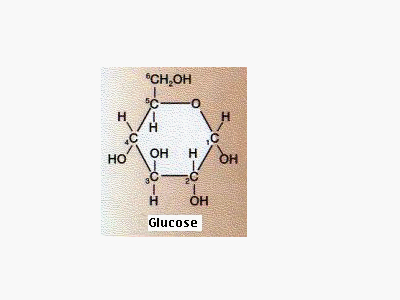
the molecule does not possess any symmertry operations. This is further confirmed by its optical activity (dextro rotatory)
The co-ordinates for the organo metallic Co compound viewing down the c-axis is worked out to ab as follows;
Since Cobalt forms predominantly Octahedral complexes with m-3m point group symmetry it is expected to occupy special positions.
The diagram indicates the staggered conformation of 1,2-dichloro ethane. There is a center of inversion (i) between the two carbon atoms (seen clearly from view A) Therefore the point group symmetry for this molecule is -1.
(i) The diagram indicates the following 3 types of symmetry elements