- Lead foil is often used for the absorption of X-rays. Given (i) the
equation for X-ray absorption,
(ii) that m/r for lead at 1.54 Å is
230 cm2/g, and (iii) that the density of lead is
11.3 g/cm3, determine the thickness (in mm) of lead foil
required to attenuate a Cu Ka X-ray beam of
intensity 108 photons/s
down to 10 photons/s. Explain why the main beam-stop for an unfiltered
non-monochromated copper X-ray source would be much thicker than this value?
[5 Marks]
- Powder diffraction patterns of organic compounds are often broadened
due to sample transparency.
(A)Briefly discuss how narrow peaks might be obtained from a laboratory
diffractometer configured for Bragg-Brentano geometry. (B)Briefly explain
how and why narrow peaks can be obtained with organic samples on synchrotron
angle-dispersive powder diffractometers.
[5 Marks]
- Crystal monochromators exploit the fact that only planes in the Bragg condition diffract X-rays in
the required direction. On synchrotron powder diffractometers, double-bounce monochromators are rotated
about a 2q axis so as to tune the instrument to a particular wavelength. If
the wavelength on the instrument has to be changed from 0.75 to 0.65Å (e.g. to avoid the
high absorption of a zirconium compound), by what angle would the monochromator have to be rotated if
Si (111) planes are used? (The d-spacing for Si (111) planes is 3.136 Å.)
Show your workings clearly in your answer.
[5 Marks]
- In energy dispersive diffraction, the equation relating an X-ray photon energy (E in keV) to
its wavelength (l in Å) is:
E = 12.398 / l What range of d-spacings can be measured for a detector designed to record X-ray photons with energies in the range 20-100 keV when the detector angle (2q) is set to 2.7°. Show your workings clearly in your answer.[5 Marks]
- For each symmetry operator listed below, state the corresponding symmetry element giving reasons for your answer:
- -x, y, -z
- 1/2+x, 1/2+y, z
- -x, -y, -z
- -x, -y, 1/2+z
- x, y, -z
- 1/2+x, -y, z
- 1/2+x, -y, -z
- 1/2-x, 1/2-y, -z
- -x, 1/2-y, z
- x, 1/2-y, z
The optimum thickness, x of the filter can be determined from the mass-absorption law:
where (m/r) is the mass absorption coefficient at the wavelength l, r is the density of the material, which for nickel metal is 8.92 g/cm3, and I(l) and Io(l) are the transmitted and incident X-ray intensities, respectively.
In (I/ IO ) / (- r (m /r )x) = x
x = In (10/108) / - 11.3.(230) = 0.00620cm
x = 0.062mm
3 Marks
An unfiltered, non-monochromated copper X-ray source would contain a much higher amount of high energy
background radiation. This radiation would be much more penetrating and so the main beam stop would need
to be much thicker than 0.062mm.
2 Marks
(A)
For organic materials the X-rays penetrate deeper into the sample than normal (they are less absorbing)
. Each reflection peak will be broadened since reflections from the bottom of the sample will be seen by
the detector at a slightly smaller 2q angle. In Bragg-Brentano geometry, the
sample is rotated so that the incident X-ray angle is always the same as the angle of the detector to
the sample surface. As 2q angle increases, the X-ray penetration increases
and there is an increased broadening of organic reflections.
The situation can be improved by depositing the organic material as a fine powder coating on a silicon
single-crystal sample holder. The 'thin' nature of the sample produces sharper peaks since the
thickness effect is reduced. However, with this set-up there could be more preferred orientation due
to the way the organic crystals lie on the substrate, and the overall peak intensities will be lower
due to greater sampling of the substrate.
3 Marks
(B)
The synchrotron concentrates the X-ray intensity into a well defined near-parallel X-ray beam (the how).
The monochromator can, therefore, be highly wavelength selective and still produce an intense beam (even
though most of the incoming beam is rejected). With a reduced spread of wavelength hitting the sample,
the range of angle representing a given d-spacing will also be reduced (from 2dsinq
=nq)(the why). The result is that peaks are sharper i.e. better
resolution).
The organic sample could be put into a glass capillary and the entire 2q
range scanned using the Debye-Scherrer set-up (the how). Since the X-rays bathe all the sample there is
no sampling of the substrate - although some scattering from the glass capillary is seen in the
diffractogram.
Comment: Explanation of incoming beam given, but not
for diffracted beam
1 Mark
sinq1 - sinq2 = cos({q1 + q2} / 2) 2 sin({q1 - q2} / 2) » sin(q1 - q2) if (and only if) q is small!
0.1 = 2dsin (q 1 - q 2)
q 1 - q 2 = sin - 1 (0.1/2d) = sin - 1 (0.1/2x3.136)
q 1 - q 2 = 0.914° i.e. q 1 > q 2
q 2 = q 1 - 0.914°
2q 2 = 2q 1 - 1.828°
Comments: Monochromator has to be rotated by
q (see model answer)
2 Marks
E = 12.398 /
l20KeV photons l=12.398/20 = 0.6199Å
100KeV photons l=12.398/100 = 0.1240Å
2 Marks
Now 2dsinq = nl
(assume n=1), also 2q=2.7° therefore q =1.35°
For l = 0.6199Å d = 0.6199 / 2sin1.35 = 13.2Å
For l = 0.1240Å d = 0.1240 / 2sin1.35 = 2.6Å
2 Marks
The range of d-spacings is 2.6 to 13.2Å
1 Mark
(You should note that none of the answers involves high-order,
i.e. n > 2, symmetry axes.)
[10 Marks]
Symmetry Element: Two-fold rotation axis parallel to the Y direction
Reason: The 180° rotation about the origin (o) in the plane of the screen causes the x and z values to invert. The y value is unaffected.
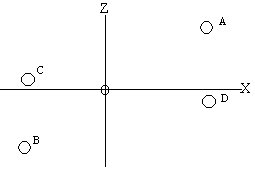
Minor comment: avoid using JPG format for line diagrams, GIF is better. Note you will lose marks in the project if you use this format for Rietveld plots. JPG is good for photos
The rotation causes A to go to B and C to go to D.
1 Mark
Symmetry Element: Translation (diagonal)
Minor comment: yes, but it would be better
to explicitly state that it is a "C" centred operator as evidently understood
by your reasoning below
Reason: A translation of half of a repeat unit in both the X and Y directions.
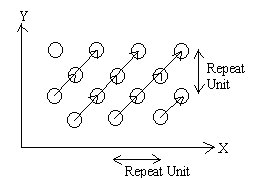
1 Mark
Symmetry Element: Point of inversion at the origin of the X,Y,Z
Reason: All points are inverted
New y = - (old y)
New z = - (old z)
1 Mark
Symmetry Element: A two-one screw axis parallel to the Z-direction
Reason: The two-fold (180°) about the Z-axis inverts the x and y values
(similar to (i)). This is followed by a translation in the Z-direction of one half the repeat unit.
1 Mark
Symmetry Element: Mirror plane perpendicular to the Z-axis and cutting the Z-axis at z=0
Reason: Similar to a mirror plane facing this page. z=0 is assigned to the
position of the plane above the page. The x and y values remain unchanged and the Z values are
inverted
1 Mark
Symmetry Element: Glide plane that is parallel to the X-direction and
perpendicular to the Y-direction (passing through y=0).
Minor comment: Better to state explicitly that it is
an a glide plane
Reason: The Y co-ordinate is reversed (due to reflection) and one half of
the repeat unit is added to the X co-ordinate (due to translation). The Z values are unaffected.
1 Mark
Symmetry Element: A two-one screw axis parallel to the X-direction (similar to (iv)).
Reason: The two-fold (180°) rotation about the X-axis inverts the y and z
values (similar to (i)). This is followed by a translation in the X-direction of one half of the
repeat unit.
1 Mark
Symmetry Element: A glide plane parallel to the Z-direction due to a
two-fold rotation axis at ¼, ¼, z and a mirror plane perpendicular to the rotation axis, passing through
Z=0 (but without translation after the reflection).
Comment: See model answer - this operator corresponds to
a single symmetry element
Reason: An atom at x,y,z goes to 2Tx - x, 2TY - y, z
Therefore
A two-fold rotation axis at ¼, ¼, z will have the symmetry operator ½ -x, ½ -y, z.
A mirror plane perpendicular to the Z-direction and passing through z=0 will invert the z values to produce
the symmetry operator ½ -x, ½ -y, -z.
0 Mark
Symmetry Element: Two-fold rotation axis at 0, ¼, z parallel to the Z-direction.
Reason: From viii), for a rotation axis with a non-zero origin, an atom at x, y, z goes to 2Tx - x, 2Ty - y, z
Therefore,
2Tx - x = - x which gives Tx=0
2Ty - y = ½ - y which gives Ty=¼
A two-fold rotation axis at 0, ¼, z has the symmetry operator - x, ½ -y, z
Excellent!
1 Mark
Symmetry Element: A glide plane due to a two-fold rotation at 0, ¼, z and
reflection from a mirror plane perpendicular to the X-direction (No translation along the Z-direction).
Comment: See model answer - this operator corresponds to
a single symmetry element
Reason: The two-fold rotation is the same as that in (ix) with a symmetry
operator of - x, ½-y, z. In this case the mirror plane in perpendicular to the X-direction (passing
through x=0). The x-values are inverted due to reflection.
0 Mark