 |
Article in Prospects Postgraduate Magazine
October 1999 School of Crystallography, Birkbeck College, University of London |
|
|
Article in Prospects Postgraduate Magazine
October 1999 School of Crystallography, Birkbeck College, University of London |
 Welcome Page
 Course Index
 Administration
 Back
Back
Graduate Courses on the Internet
Huub Driessen, David Moss, Clare Sansom, Ian Tickle and Jeremy Karl Cockcroft
Department of Crystallography, Birkbeck College, University of London
Major changes
No one will deny that the Internet and computer technology are already changing the education system at all levels. In the next decade, the way most people study for higher degrees will change: influenced not only by technological change but by an increased need for lifetime learning, and by financial pressure. The Open University has offered masters degrees by traditional distance-learning methods for many years. Increasingly, now many institutions are offering study material and even complete courses over the Internet.
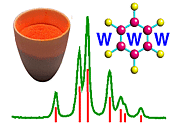
Our Department of Crystallography at Birkbeck College has been in the vanguard of such developments since 1993. For the past few years we have been running two graduate courses on the Web: Principles of Protein Structure (PPS) and Protein Crystallography (PX). This October we will start a third course: Powder Diffraction (PD). Students who complete one of these yearlong, part-time courses successfully receive the award of an Advanced Certificate from Birkbeck College. This is a graduate level qualification, approximately equivalent to half an MSc degree.
What are the advantages of Internet-based teaching? Students study part-time in their own time, and at their own convenience. The computer and Internet connections needed are cheap and readily available. Students may benefit from part-time tutors who have a world-wide reputation in their fields. Fees are low, and living expenses non-existent, which opens access to students from emerging economic areas. Finally, our students use public domain software to interact with the multimedia teaching material, e.g. by rotating proteins in three dimensions.
Generally the courses run on the basis of a three-term year. In the first and second term the course material is delivered, while in the third term the students do the course projects. Reports on the projects have to be submitted in Web form using HTML. Each course starts with an introduction to the Internet, and the Software needed to successfully complete the course.
Course Materials
The course materials have been mainly developed in-house although links to relevant external material are provided. Where this was initially not the case there has been a tendency towards in-house material. This is important to provide a house-style and to avoid uneven quality of materials and broken links, which is due to the ephemeral nature of the Internet. There is a large variety in the nature of the course materials. These include traditional book-like text in the English language and multimedia materials consisting of text, images, image maps, databases, and "Movies". So far we have not used course materials based on sound. There are additional multimedia materials consisting of interactive software, and the "Fourier" program, designed and written at Birkbeck for the purpose of self-teaching the basic principles of Fourier transforms. Paradoxically the course materials are generally not based on the most up-to-date technology versions, but are lagging a little bit behind. This aims to avoid buggy software and ensures that all students can study the material and not just those that have the latest computers and browsers. We have tested the course materials on Unix Workstations, PCs and to a lesser extent on MACs. The best browsers to use are Netscape and Internet Explorer (version 3.0 or later for both). The minimum computer requirements are the equivalent of a 50MHz 486 computer with 8Mb RAM and a 14" screen, where it would be helpful if the screen can be configured for 1024x768 pixels and 8 bit colour. The biggest problems are usually encountered not with the computer, but with a slow Internet link.
Supervision
Course material is released in sections (usually self-contained) mounted on the Internet, which the students study at their own pace in their own time, although the optimum pace is set by the release dates. Release notes provide the student with the aims and objectives of the sections. The courses provide a variety of means of communicating with the tutors: e-mail lists, individual e-mail support, and BioMOO, where tutors and students meet, which can be compared unrespectfully to a high-quality chat-room. There is great variety between the courses in the number of sessions run. Some sessions are run at midnight to allow students from the Pacific Rim to participate.
Assessment
Throughout the year assignments with open questions are set, which the students have to answer by submitting web pages. These are marked, and general and individual feedback is given. The marks count towards the final course result. Again there is great variety between the courses with respect to exact procedure of the assignments. In addition there are self-assessment quizzes (PPS) based on multiple-choice questions, which are marked automatically.
Formal assessment consists of two components, the projects and an examination. The projects have to be submitted as web pages for marking. The examination by unseen paper takes place by the student sitting in person at one of a number of local centres temporarily established throughout the world. This is the only part of each course that uses traditional methods. To ensure quality control each course has an associated external examiner from another university or industry.
Annual Improvements
Is the Internet based course experience second-rate? Manifestly not, as can be seen from the comments of students who have followed our courses. Students and tutors develop a rapport as in any other course, although they generally will never meet face-to-face. The courses are rigorous and expect regular study to complete. The time to be devoted (6 hours/week) to the materials is as much as would be required for face-to-face attendance. At this early stage they also require an interest in the Internet as a medium. The quality of the materials is high, as you would expect from materials that go through annual improvements. Soon students will be able to combine two advanced certificates, with a project, to obtain an M.Sc. degree from the University of London, where the project may be taken at Birkbeck or at distance.
Welcome Page
Course Index
Administration
Back
|
© Copyright 1997-2000.
Birkbeck College, University of London.
|
Author(s) Jeremy Karl Cockcroft Huub Driessen David Moss Clare Sansom Ian Tickle |